Kenya, May 1, 2024 — infopulsetoday.com — The floodwaters still have not receded.
Across Kenya, the toll now stands at 181 dead. That number will rise. The ground is saturated.
The rains keep coming. And every day, more roads wash out, more homes collapse, more families pack whatever they can carry and walk toward higher ground they may not reach in time.
This is not a sudden crisis.
It is a slow drowning. And the country is running out of dry places to put people.
The geography of Kenya works against it in moments like this. The country is a patchwork of plains, mountains, and coastlines—beautiful in a postcard, brutal in a flood. Water runs off the highlands and collects in the lowlands.
The lowlands are where people live.
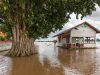
Mombasa, built on an island, is taking the worst of it. Low-lying neighborhoods there are simply gone, swallowed by water.
Homes that stood for decades are now piles of wet rubble.
Businesses that survived the pandemic, the drought, the election uncertainty—they are underwater too. Literally.
Kisumu, on the shore of Lake Victoria, is not faring much better.
The lake is rising. People there have fled to higher ground. But higher ground is not infinite.
And every day, more arrive. The Kenyan government has sent emergency services.
Aid is moving.
But the scale is wrong. The terrain is wrong.
The water does not care about the plan. Rescue crews cannot reach every pocket of stranded people. Roads that were supposed to be lifelines are themselves destroyed.
Bridges are gone.
Supply chains are snapped. The city of Mombasa, a major port, is cut off from parts of its own hinterland.
That has consequences.
Trade stalls. Goods rot.
Prices spike.
The economic damage is not tomorrow’s problem—it is already here. Kenya has 53 million people. A big share of them live in cities like Nairobi, Mombasa, and Kisumu.
Cities concentrate risk. When a flood hits a city, it hits harder.
More people in a smaller space.
More infrastructure to break. More chaos to manage.
And the cities keep growing, pushing into floodplains and hillsides that should never have been built on. The water finds them there. There is a bitter irony in all this.
Kenya’s geography and climate make it one of the most biodiverse places on Earth.
Rare species, endangered species—they live here because of the same rains that are now killing people. The country is a haven.
But a haven can flood.
What is at stake is not just the current death toll. It is the ability of this country to absorb a shock and keep going.
Every road that washes out is a road that will take months to rebuild.
Every home destroyed is a family that will spend a year or more in a tent or a relative’s cramped room. Every business that closes is a job that does not come back. The economic impact compounds.
The social fabric frays. People get desperate.
The government is doing what it can.
But resources are finite. The flooding is not.
The rains are not done. The water has not peaked. The 181 dead are not the final number.
They are just the ones we can count today.
This is what a slow disaster looks like. No single explosion.
No dramatic collapse.
Just water, rising. Day after day.
And a country trying to stay above it.